Birding Echoes
Bringing the mindful birding mindset to birders of all abilities with Merlin Bird ID

tldr;
I pitched this project to Merlin Bird ID and designed audio-first retrospective and social features that bring mindful birding to birders of every visual ability. These features are on track to be implemented in the app by spring 2027.
Overview
Birding is traditionally a checklist-driven activity: spot it, name it, log it, move on. However, blind birders usually don't bird this way, since they have to bird by ear. They slow down. They listen. One blind birder I talked to even said
The goal of this project was to design for this beautiful, mindful way of birding.
When I looked into blind birding, I saw more than an accessibility gap. I saw a universal design opportunity: start from the perspective that blind and low-vision birders already have, and the experience gets better for birders of every visual ability, not just theirs.
How might we bring the reflective mindset of mindful birding to everyone?
Securing the Partnership
Our program offered an easier path: a pre-scoped project with a sponsor already lined up. I pushed the team to skip it and find our own problem and partner instead, with no guarantee anyone would say yes.
I did the desk research and business case, then built a pitch deck showing Merlin what we'd bring: an underexplored user population, a research angle aligned with their audio-first product, and a fully scoped study ready to execute inside their real roadmap constraints. I presented it to Merlin's team. They signed on and thanked us for the rigor behind it before we'd done a single interview.

Initial pitch deck to Merlin to partner for our research and design capstone project.
Research Approach
We recruited blind, low-vision, and novice birders for the research: novice birders tend to be less visually reliant, often not yet having invested in binoculars, which made them an ideal group to test against, showing that the designs held up not just for blind birders but for the wider birding community.
Our initial research followed a four-part plan. Over ten weeks, my team and I ran 6 semi-structured interviews, 2 field observations, analyzed nearly 6,000 app reviews, and topped it off with 2 mixed-visibility co-design sessions.
I’ll just be going over what had the biggest impact on our designs, but for the full depth on all four, including the field observations and the app review analysis, read the complete write-up on Medium.
Interviews
Although none of the participants we interviewed knew the term mindful birding, all of them practiced it in some way, shape, or form.
"I had a biology quiz this morning, so I just went [birding]. Cleared my brain before I did a final study. That definitely is mindful birding, kind of giving myself a break. And, enjoying being outside."
Novice Birder

"I'm waiting just even in front of my house waiting for transportation. And I'm just tuning into what I'm hearing around me. It can help pass the time while I'm waiting for my ride. And and just appreciate hearing what I'm hearing and enjoying being outside and not worrying about when is my ride coming?"
Blind Birder

We saw gaps in the post-birding experience. No one was going back to their past birding media (recordings, photos, videos) unless they were sharing them with others.
Design Approach and ideation
We generated nearly 100 ideas. We then sorted each idea into categories based on the kind of connection it created.

Vibe coded ideation visualization dashboard
To make sense of that volume, we used a dashboard that let us filter and plot ideas against each other. It showed us where our thinking clustered and where it was thin.

Our early concepts show it. Were novel, but it relied on visuals and didn't get at the heart of what our users needed. We had chased innovation so hard that we lost the point of the project: enabling mindfulness through audio-first experiences.

The patterns exposed a problem. Despite months of research with blind birders, most of our ideas depended on sight. We had fallen into the trap we set out to avoid.

So we went back to the research and asked what our blind and novice birders actually wanted. The answer was simple: to learn and to reminisce. We rebuilt the concept around those two needs, starting with sound.
What We Designed
The clearest signal across the research is that people rarely revisit their own past recordings or sightings, not because they don't value them, but because nothing prompts them to. Three additions to Merlin answer that directly.
My Recordings
Past sightings used to be buried three taps deep. We moved them to the front of the app, so looking back takes one tap instead of a search.


Birding Mixes
Birders turn their own recordings into a personal, shareable mix.

Birding Insights
Now your birding experience can be quantified for you to learn and share.

Validation
I helped run in-field usability testing with novice sighted birders on their own phones to keep the context real, and remote testing with blind and low-vision birders to check screen reader support and large-scale accessibility. They averaged an 88.5% clearance rating across four tasks and had some heartwarming things to say about our designs.
" [I] like the idea of mindfulness and looking at the history. Now it’s like developing a personal story on birding"
Blind birder

"People are gonna be blown away when seeing this. This is really cool."
Low Vision Birder

"The intentional side and sharing side of things would strengthen the birding community."
Low Vision Birder
Impact
Before this, Merlin had never done any generative research. They also hadn't done research with blind or low-vision users, and rarely got the chance to test with novice birders either, despite novices being most of those who actually use the app day-to-day. I'm proudest that our research wasn't just a set of findings; it changed who they research with and consider in their design process going forward.
Our presentation landed well enough with Merlin's team that we're still working with them, carrying these findings into product by spring 2027.
Learnings
Before this project, I had never gone birding, conducted research with blind and low-vision participants, or facilitated a co-design activity with mixed visual abilities in the room. Going directly to Merlin forced us to be rigorous before we even had a client. Our preparation was our credibility.
The deeper lesson was about mixed-ability research design. The friction between perspectives in the room surfaced tensions that homogeneous groups would have smoothed over, and taught me that centering underrepresented users doesn't narrow a design problem. It opens it up.
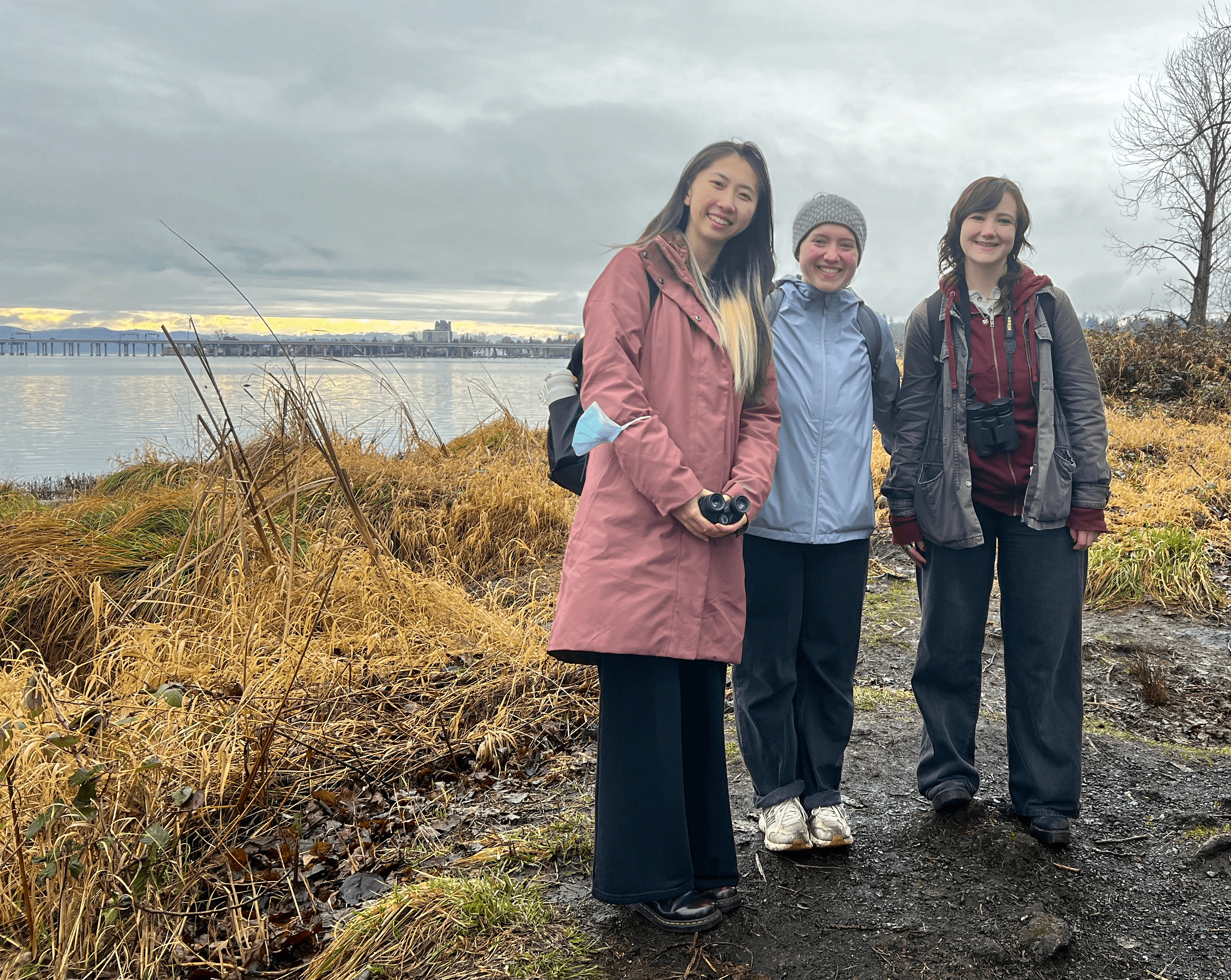
My first time birding with my team